The Viking gear guide for people who look stupid and don’t care.
Let me describe what I looked like last Tuesday at 7:30am on a public hiking trail.
Phone mounted to my chest like a police body cam. Noise-canceling earbuds jammed in both ears. A cable running from the phone down to a portable battery in my hip pocket, giving the impression that I am perhaps medically tethered to my own torso. A small backpack with a laptop poking out of it. Fingerless gloves because it was 8°C and I needed to swipe my screen without stopping. And a wide-brimmed sun hat that my mother would describe as “a choice.”
A woman walking her dog looked at me, looked at her dog, and the dog seemed less confused than she was.
I don’t care. I shipped a feature before she finished her loop. But I understand that for many aspiring Vikings, the “looking like a complete lunatic in public” barrier is real. So let me walk you through every piece of gear I use, why I use it, and how stupid each one makes you look on a scale from “mildly eccentric” to “someone should check on him.”
The phone mount (stupidity rating: 8/10)
This is the cornerstone of the Viking setup and also the thing that makes strangers most concerned about your wellbeing.
You have three options: chest mount, neck mount, or hand. Hand is not an option. If you’re holding your phone for four hours on a trail, your wrist will file for divorce by day three. You need your hands free for balance, for gestures (you will gesture while arguing with Claude about state management, this is unavoidable), and for the occasional scramble over rocks.
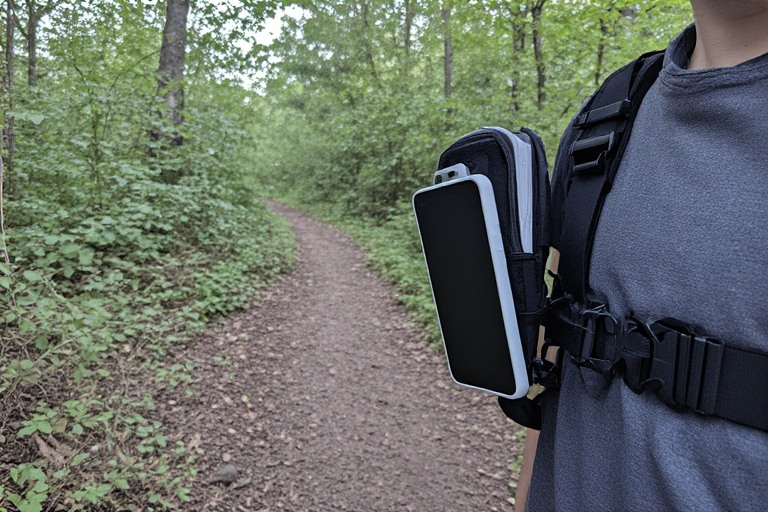
Chest mount: the classic. A harness-style strap that puts your phone right on your sternum. You look like you’re livestreaming your hike or gathering evidence for an insurance claim. But it’s stable, it keeps the phone at a readable angle, and your hands are completely free. The downside is that reading code on your own chest requires a neck angle that will eventually create the very posture problems you’re trying to escape.
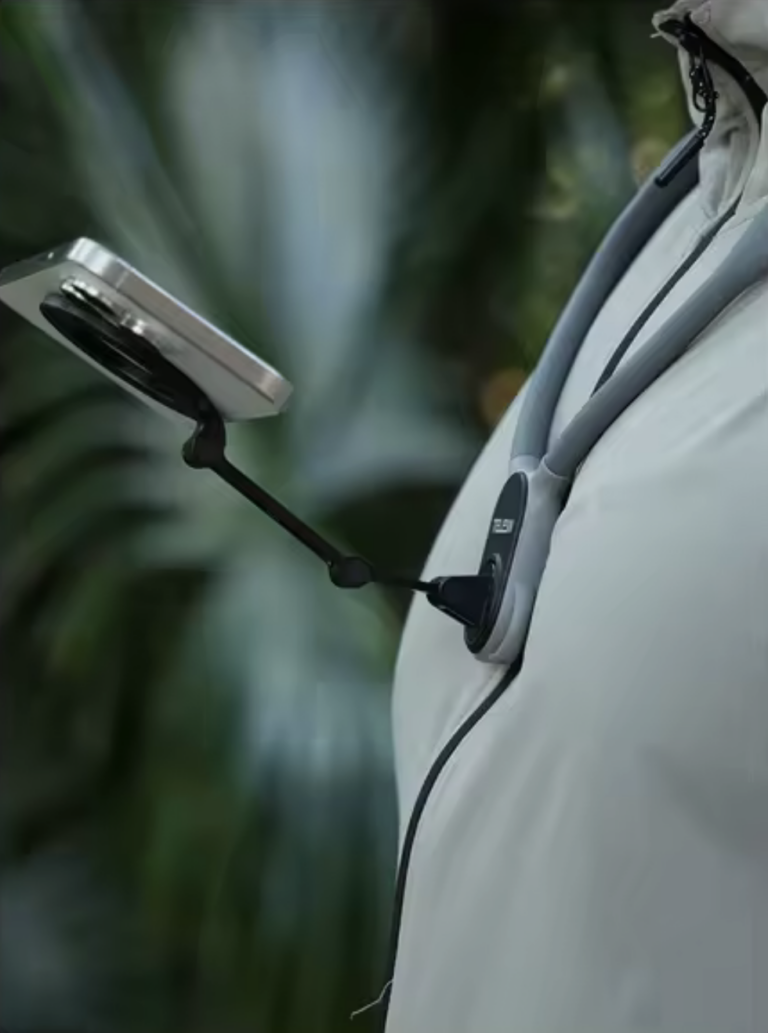
Neck mount: my current daily driver. A magnetic mount that hangs the phone around your neck like a very expensive pendant. Slightly less insane-looking than the chest mount. The phone sits lower, which is better for glancing at but worse for voice pickup if it’s windy. I use this 80% of the time.
Both cost between $15 and $30. This is the cheapest piece of gear that will change your life the most. There is no excuse not to try one.
The earbuds (stupidity rating: 2/10)
Everyone wears earbuds on trails now. This is the one piece of Viking gear that doesn’t make you look weird at all. Bless the normalization of AirPods.
What matters here is noise cancellation and microphone quality. You’re talking to an AI on a trail, which means wind, birds, streams, other hikers, and the occasional dog that wants to contribute to your architecture review. You need earbuds that can isolate your voice from all of that. Cheap earbuds will turn your prompts into garbled noise and Claude will respond to things you never said.
I use AirPods Pro. They’re fine. Not amazing in heavy wind, but good enough for 90% of conditions. If you’re Viking in exposed or windy terrain regularly, look into bone conduction headphones with a boom mic. They look significantly stupider (back up to 6/10) but the voice clarity in wind is worth it.
One rule: never use both earbuds with noise cancellation on full if you’re on a trail with bikes or runners coming from behind. This is a safety thing. I keep one ear on transparency mode or use the bone conduction option specifically because I’d rather not get flattened by a mountain biker while debugging a race condition. That would be ironic in ways I don’t want to explore.
The portable battery (stupidity rating: 3/10)
Voice chat with an LLM, screen on, cellular data, GPS running in the background. Your phone battery is going to die. Not “might die” or “could die if you’re out for a long time.” It will die, with certainty, somewhere around hour three.
A 20,000mAh portable battery fixes this completely. It’ll keep your phone alive for two full days of heavy Viking use. It weighs about 350 grams, fits in a jacket pocket or a small backpack pouch, and costs around $25-35.
I keep mine in my hip pocket with a short cable to the phone. The cable is the only part that looks weird, but we already established that you look weird anyway, so this is incremental weirdness at best.
Carry the battery. Every time. Don’t Viking without it. Running out of battery four miles from home with unfinished code is a special kind of frustration that I would not wish on anyone.
The laptop (stupidity rating: 5/10)
You don’t always need it. Most Viking days are 80-90% voice and phone. But there are moments when you need to look at actual code on an actual screen, type something complex, or review a PR that’s too dense for a phone display.
I carry a lightweight laptop (under 1.3kg) in a slim backpack. Not every day. Maybe three days a week. It stays in the bag until I find a bench, a picnic table, a flat rock, or any horizontal surface that will hold a computer for twenty minutes. I do my focused typing session, close the laptop, and keep walking.
The key is to think of the laptop as a tool you use during breaks, not as your primary work device. The primary device is your voice. The phone is the interface. The laptop is for the 15% of work that voice can’t handle.
If you’re going to carry a laptop, get a bag with a dedicated padded sleeve and make sure it’s comfortable over distance. You’re going to walk a lot of miles with it on your back. Skimping on the bag to save forty bucks is false economy when your spine is involved.
The gloves (stupidity rating: 4/10)
Cold weather Vikings, listen up. You will need to interact with your phone screen. Touchscreen gloves exist but they’re universally terrible. The touch accuracy is bad, the swipe recognition is worse, and you’ll spend more time fighting the gloves than doing actual work.
Get fingerless gloves. Or get full gloves and cut the index finger and thumb tips off yourself. You will look like a Victorian pickpocket. You will also be the only person on the trail who can actually use their phone when it’s 5°C, which in Viking terms makes you elite.
For serious cold (below zero), I switch to a setup where the phone stays in a chest mount inside my jacket with a small opening for the screen, and I control everything by voice. This looks even more insane than usual but it works.
The hat (stupidity rating: variable)
Sun protection matters more than you think. You’re outside for four to six hours. That’s real UV exposure, especially at altitude or in summer. And if you’ve ever tried to read code on a phone screen in direct sunlight, you know that glare is a genuine productivity killer.
A wide-brimmed hat solves both problems. Sun off your skin, shade on your screen. It also makes you look like you’re about to go fly-fishing or lead a safari tour, which is a significant aesthetic departure from the tech worker baseline.
I own a hat that I would never wear in any social situation. On the trail, it’s the most practical item I carry. Vanity has no place in Viking. Only output and UV protection.
For a more subtle option, a standard baseball cap works for casual glare reduction but leaves your neck and ears exposed. Your call. Skin cancer doesn’t care about your aesthetic preferences.
The shoes (stupidity rating: 0/10, importance rating: 11/10)
I saved this for last because it’s the most important and the least funny.
Bad shoes will end your Viking career. Not slowly, not gradually. Abruptly. One bad blister, one rolled ankle, one day of aching knees from insufficient support, and you’ll be back at your desk telling yourself that Viking was “an interesting experiment.”
Get proper trail runners. Not running shoes. Not sneakers. Not hiking boots (too heavy for daily use). Trail runners. They’re designed for exactly the kind of movement Viking requires: long distance, variable terrain, all-day comfort.
Spend the money. This is the one piece of gear where budget options will actively hurt you. I went through three pairs of cheap trail shoes before I bought a proper pair, and the difference was so dramatic that I genuinely got angry at myself for wasting three months on blisters.
Break them in before your first real Viking day. Wear them around the house, on short walks, to the grocery store. Your feet need to know these shoes and these shoes need to know your feet. Treat this relationship with the seriousness it deserves, because your feet are now your commute, your standing desk, and your gym, all at once.
The full Viking loadout, summarized
Phone mount (neck or chest): $15-30. Noise-canceling earbuds: $50-250 depending on your standards. Portable battery (20,000mAh): $25-35. Lightweight laptop + good bag: you probably already own these. Fingerless gloves: $10-15. Wide-brimmed hat: $20-40. Proper trail runners: $100-160.
Total cost to go Viking, assuming you already have a phone and a laptop: roughly $200-350 for everything else. That’s less than one month of the coworking space membership you’re about to cancel.
You will look stupid. You will look like a person who has made a series of questionable fashion decisions in service of an idea that most people haven’t heard of yet. A tourist who got confused. A tech worker who wandered away from the office and nobody came looking.
But you will be outside. You will be moving. You will be building. And six months from now, when your back doesn’t hurt and your bloodwork is clean and your app is live and your resting heart rate makes your doctor raise an eyebrow, you will not care even a little bit about how you looked on that trail.
The gear doesn’t make the Viking. The walking does. The gear just makes the walking possible without your phone dying, your fingers freezing, or your feet staging a revolt.
Now get out there. Look stupid. Ship something.